


Hi social pro 👋
Almost every brand says they want community. But they’re still looking for it in the wrong places - new channels, new formats, new campaigns…
Meanwhile, it’s already forming every day in their own comment sections.
This week we’re looking at three brands that built community by doing something deceptively simple: listening to what their audiences were already saying in the comments, and acting on it.
Let’s get into it 👇
— Brett
Join us LIVE next Thursday
I’m sitting down with Live Nation’s social listening lead, Ariel Leavitt, next week in our first ever Social Intel Innovators Live virtual event - and you’re invited!

We’ll be chatting about where social intelligence is headed in 2027, and there’ll be plenty of opportunities to ask Ariel your burning social insights questions.
From the feed: 3 brands that built community in the comments section
Building community has become one of the most talked about goals in social media, and one of the least understood.
The instinct is to launch something new - e.g. a broadcast channel or Discord server - but the brands doing it best in 2026 are paying attention to the conversations that are already happening in their comment sections, and finding ways to genuinely participate in them.
Here are three brands that found their community by listening to what was already being said in the comments - and acting on it.
Vita Coco: Listening in someone else’s comment section
In early 2026, creator Romeo Bingham posted a made-up jingle for Dr Pepper that went viral. Within days, brands were flooding the comments asking for jingles of their own. Vita Coco spotted the momentum building, moved fast, and turned it into a paid partnership before the moment passed.
@romeosshow Replying to @vitacoco this would go crazy with some steel drums. #vitacoco #coconutwater #beverage #jingle
The jingle Romeo created racked up nearly 40 million views. The campaign drove Google searches for the brand to a four-year high, gained 130,000 new TikTok followers in a month, and pushed Vita Coco past 1 million TikTok followers overall. CMO Jane Prior attributed much of it to the brand’s willingness to find and act on organic moments quickly. “It’s often the organic campaigns that generate the most value,” she said.
The community was already there - in the comment section of someone else’s viral video. Vita Coco just showed up at exactly the right moment, and turned it into an opportunity.
Raisin Bran: Comments as creative strategy
Raisin Bran’s Threads account, run through VaynerMedia, has built one of the more interesting brand communities on social in 2026 - almost entirely through comment sections.
The team calls their approach CasC: Comments as Creative. Rather than waiting for audiences to come to them, they actively mine Threads for conversations where Raisin Bran’s mascot Sunny - a 4.6 billion-year-old sun with strong opinions - has something genuine to add. Cereal debates, astronomy discussions, reading communities, whatever is moving on the platform that day.

The breakthrough moment came when a breakup text went viral on Threads: someone’s ex had mocked them for having a library card. The Raisin Bran team spotted it, responded in character - “If you love Raisin Bran, you’re legally required to have a library card” - and ended up with 8,000 new followers from a single post.
What made it possible was infrastructure as much as instinct. The team had negotiated a faster approval process with their client specifically so they could move at the speed of a conversation. Lead Creator Sam Lurie put it directly: “The brands that are winning have this process in place.” Showing up in the right comment section at the right moment requires operational setup that takes time to build.
CAVA: Long-term listening
The Vita Coco and Raisin Bran examples are about speed - i.e. spotting a moment and moving on it fast. What worked for CAVA, however, was patience.
CAVA’s white sweet potatoes debuted in 2021, then disappeared after that season. For years, comments asking for their return kept appearing across CAVA’s social channels - the same ask repeating from the same vocal community, long after many brands would have stopped paying attention.
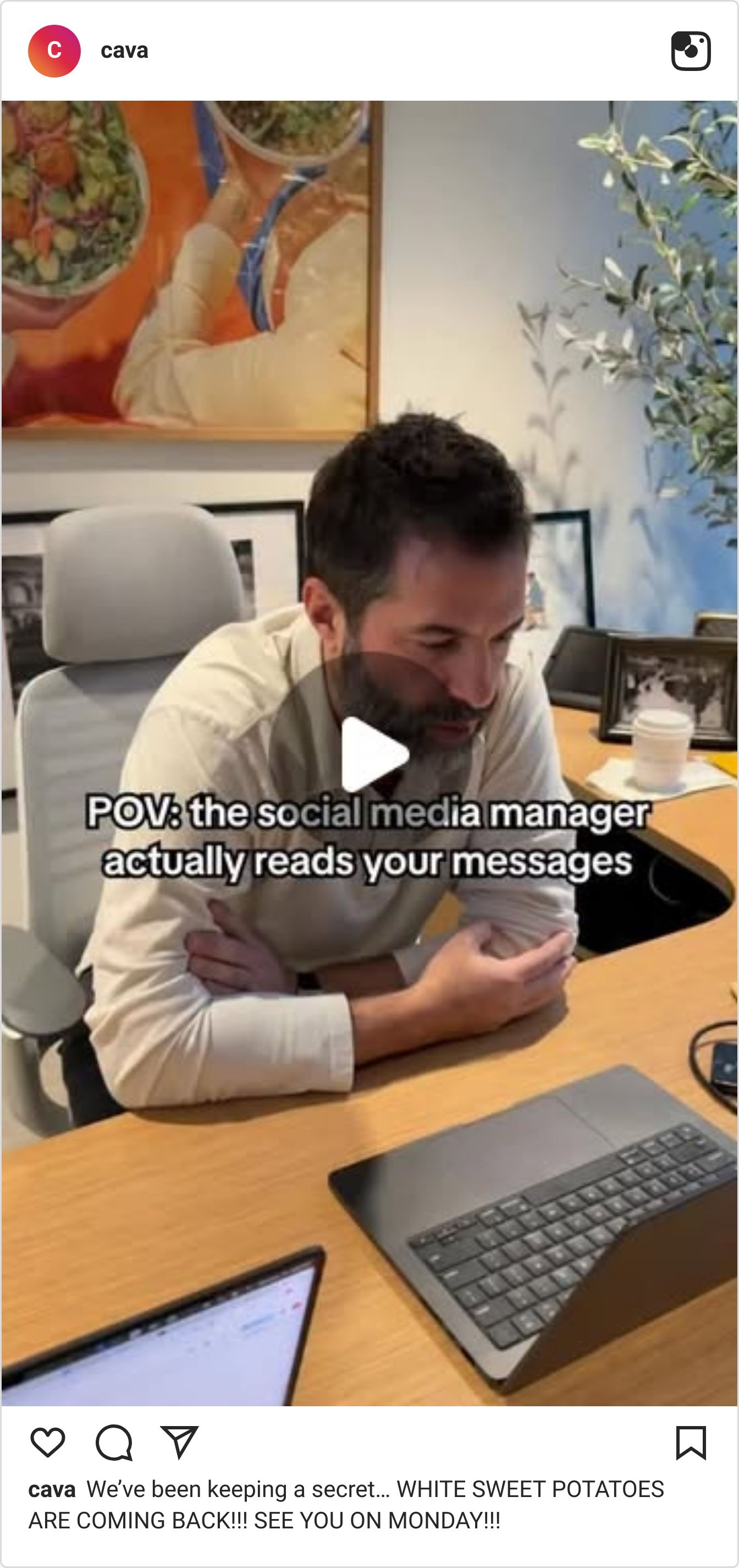
When CAVA finally brought them back in early 2026, co-founder Ted Xenohristos personally hopped on Zoom calls with the superfans who had been asking for years and told them directly that their persistence was what made it happen. CAVA then shared those calls on Instagram. The comment section that followed was exactly what you’d expect from an audience that had been waiting four years: “I’m actually crying tears and calling everyone I know.”
The community formed in the comments over years of consistent, vocal audience engagement. The return of a menu item became a moment because CAVA had been listening long enough to know it would.
What these three brands have in common
None of these brands tried to manufacture community. It formed organically in the comment section, and each brand earned their place in it by simply paying attention - to someone else’s viral video, a breakup text going viral on Threads, and to four years of fans begging to bring their favorite menu item back.
Community shows up when brands are genuinely present in the conversations their audiences are already having - and the comment section is where those conversations live.
On our radar

Hollywood is going where audiences already are.
Sony Pictures has hired Fede Goldenberg, former Head of Film and TV Partnerships at YouTube, to run Screen Gems - its genre label behind Resident Evil and Underworld. The move is a direct response to the box office performance of films like Backrooms and Obsession, both made by YouTube-native filmmakers with devoted digital followings.
The logic is straightforward. Digital-native filmmakers arrive with built-in audience trust that studios would otherwise spend millions trying to manufacture. Goldenberg’s job is to find those filmmakers and bring their projects to theatrical.
Why we’re interested as social analysts: the audiences shaping what gets greenlit in Hollywood are the same ones leaving comments on YouTube videos right now. Which means that understanding what those audiences think, want, and respond to has never been more commercially consequential.
Trend watch
What the Siftsy team has been reading, saving, and talking about this week.


Thanks for reading The Signal.
If something here sparked a thought or reaction, drop it in the comments (aka reply back here).
See you next week,
Research and editorial support by Amy Watts